
The Healing Power of Negative Ions: Why Living Water Makes You Feel Alive
That 'natural high' beside a waterfall isn't in your head — it's in the air. Here's the science of negative ions, the Lenard effect, and how a living water feature brings the wellness of a mountain stream to your California estate.

- Negative ions are oxygen or water-cluster molecules that have gained extra electrons, giving them a net negative electrical charge.
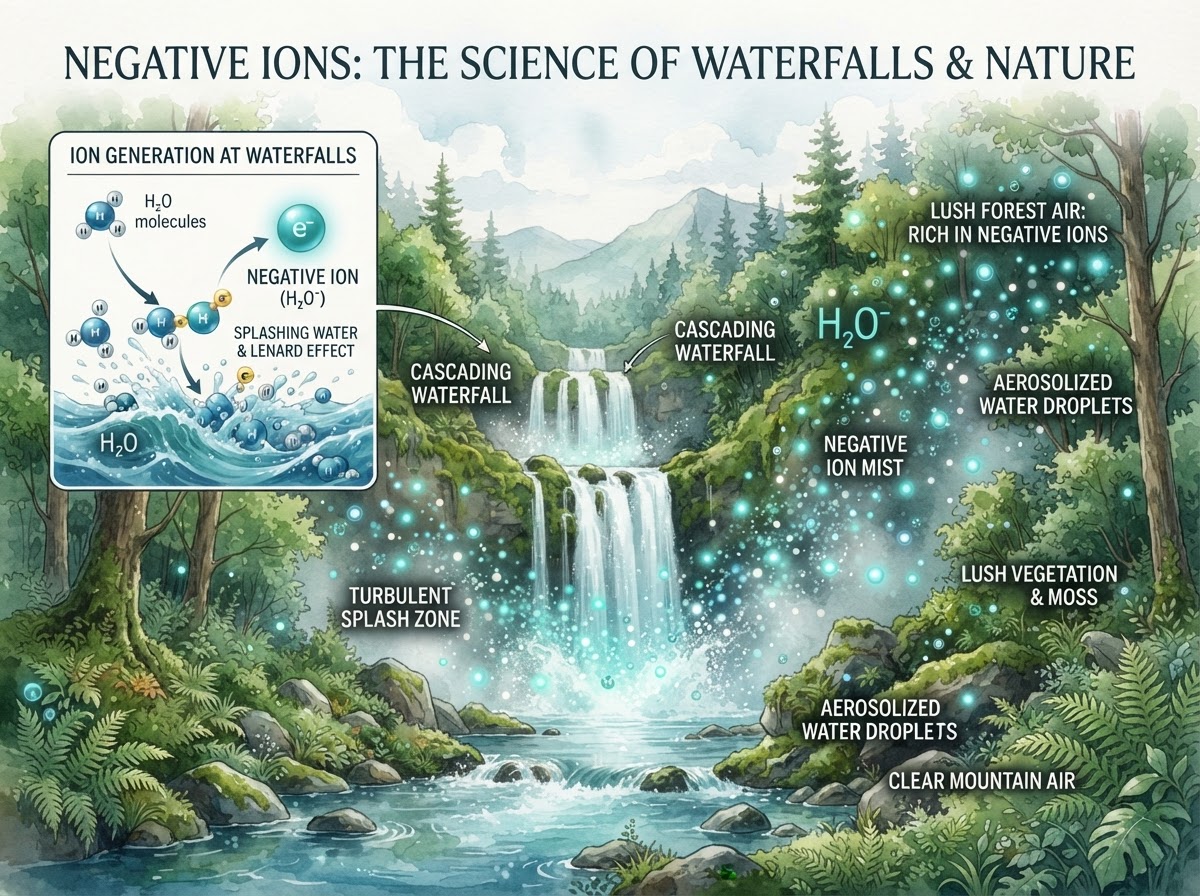
- Moving, splashing water generates negative ions through the Lenard effect — the 'waterfall effect' first measured in 1892.
- Negative ions are abundant in nature (waterfalls, forests, coasts, after storms) and depleted in sealed, air-conditioned indoor air.
- Research links negative-ion exposure to elevated mood, lower stress, better sleep, and relief from fatigue — partly through serotonin regulation.
- Negative ions attach to dust, pollen, and smoke, causing particles to clump and fall out of the air — water-rich environments literally scrub themselves clean.
- Any backyard waterfall, stream, or koi pond generates the same negative ions continuously — the wellness is the beauty.
Stand beside a crashing waterfall in the deep woods, walk the shoreline just after a thunderstorm rolls through, or simply sit on a mossy stone beside a tumbling mountain brook. Almost everyone reports the same thing: an inexplicable lift, a clearing of the mind, a settled calm — what we casually call a 'natural high.' It is not the view alone. It is the air itself. More precisely, it is the invisible abundance of negative ions that living, moving water creates wherever it falls.
To understand why water makes us feel this way, we have to look at the smallest scale. An ion is simply an atom or molecule that has gained or lost an electrical charge. A negative ion — sometimes called a 'minus ion' — is an oxygen molecule, often clustered around a water molecule, that has picked up one or more extra electrons. That tiny surplus of negative charge is the whole story. It sounds almost too simple to matter, but those charged molecules are doing something profound to the air you breathe, and, increasingly, the science suggests, to the mind behind it.
Here is where water enters the picture. When water crashes, tumbles, splashes, and sprays — over stones, against banks, through open air — the droplets shear apart. As they break, the smaller fragments carry away a negative charge, leaving the surrounding air measurably richer in negative ions. Physicists call this the Lenard effect, after Philipp Lenard, who first measured it in 1892; most of us know it simply as 'the waterfall effect.' It is the reason the air at the base of a cascade feels different from the air a hundred yards downstream.
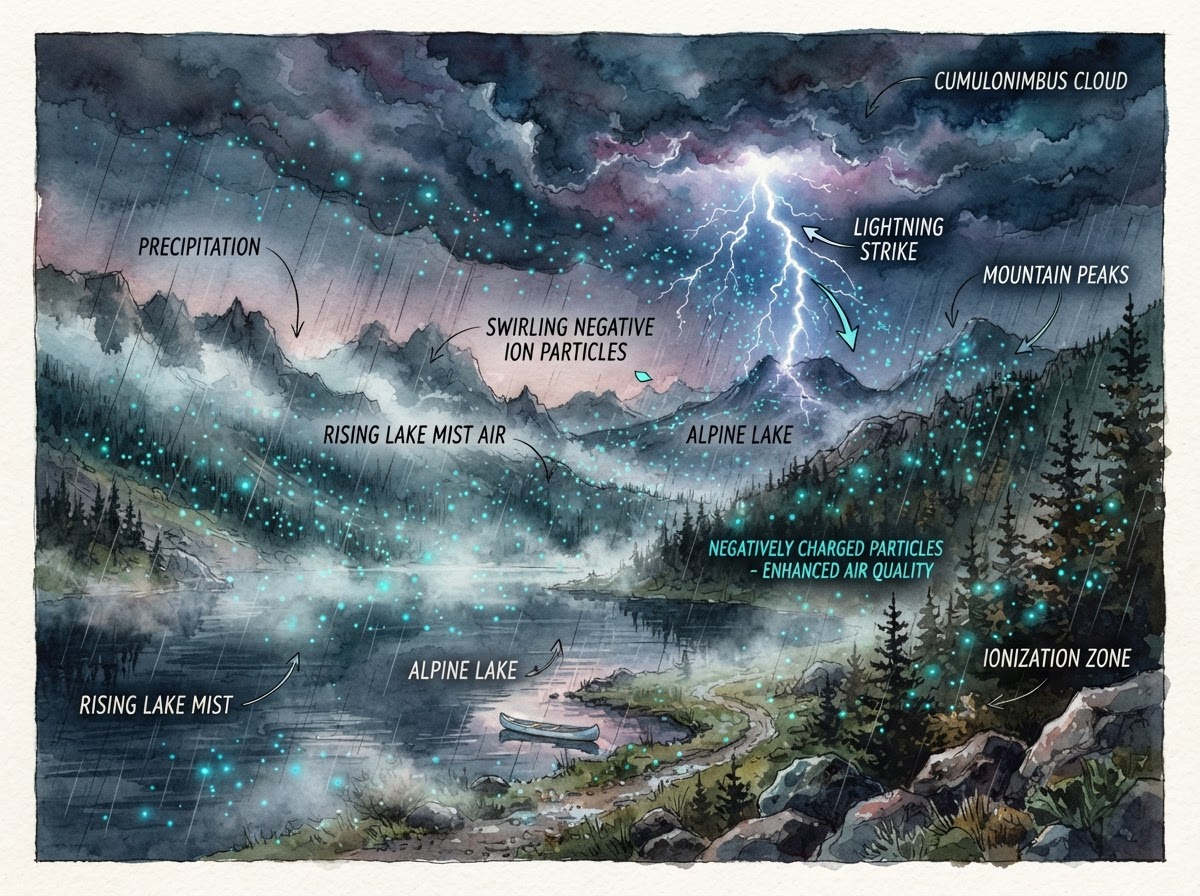
This is why negative ions are so unevenly distributed in the world. They are abundant wherever water is moving and air is open — at waterfalls, along ocean shorelines where surf crashes endlessly, in forests after rain, and in the charged air that follows a lightning storm. They are depleted, sometimes drastically, in the places modern humans spend most of our time: sealed, air-conditioned offices, heated interiors, and the still, smoggy air of dense city centers. The indoor air we have engineered for comfort is, ironically, the air most stripped of the very charge that makes natural air feel alive.
What does breathing that charged air actually do? Decades of research — from the mid-twentieth-century ionization-chamber studies through contemporary Japanese and European clinical work — have linked negative-ion exposure to a cluster of measurable effects: elevated mood and a reduction in the symptoms of mild depression and seasonal affective disorder, lower reported stress and anxiety, improved sleep quality, and a lift in daytime alertness. Several of these effects are thought to run through serotonin, a neurotransmitter deeply involved in mood regulation.
There is a reason a quiet pond at dusk can feel as restorative as a week of vacation. The biophilic pull of living water is not romantic indulgence; it is a measurable settling of the nervous system. Researchers studying restorative environments repeatedly find that proximity to natural water — moving, oxygenated, alive — is associated with lower cortisol, steadier heart rates, and that subjective but very real sense of the shoulders dropping and the mind clearing.
The same charge that lifts your mood also cleans the air you breathe. Negative ions attach themselves to airborne particles — dust, pollen, mold spores, pet dander, smoke, and the microscopic soot of traffic — giving each particle a slight charge. Charged particles are drawn to one another, clumping together until they grow heavy enough to fall out of the breathable air and settle onto surfaces. A negative-ion-rich environment is, in effect, constantly and quietly scrubbing itself.
This is why the air beside a waterfall rarely feels dusty, why a forest after rain seems to sparkle, and why so many allergy sufferers report genuine relief in the mountains or on the coast. The water is doing what no static, sealed room can do on its own — it is keeping the air in motion, charged, and perpetually renewing. The wellness and the cleanliness turn out to be the same phenomenon, viewed from two different angles.
That crisp, almost electric freshness you feel the moment a thunderstorm passes is the same effect on a grand scale. Lightning ionizes the air wholesale, and the heavy rain churns the atmosphere like a waterfall the size of a county. For an hour or two, the outdoor negative-ion count can spike to extraordinary levels — and for that hour, the world genuinely does smell and feel cleaner. You are not imagining it. Your senses are reading a real, measurable change in the chemistry of the air.
There is a name for the deeper reason all of this matters to us. In 1984 the biologist E. O. Wilson proposed the biophilia hypothesis: that human beings carry an innate, evolutionarily ancient affinity for living systems and the natural world, and that we flourish — measurably, in mind and body — when that affinity is honored rather than starved. Living water is perhaps the purest expression of biophilia. We did not evolve beside air conditioners. We evolved beside streams, pools, and rain. A water feature is not a decoration; it is the return of a familiar and necessary presence.
Which brings us home — literally. The Lenard effect does not care whether the splashing water is a Sierra cascade or the waterfall we hand-build at the edge of your patio. Any moving, tumbling, oxygenating water releases negative ions into the air around it, continuously, for as long as it runs. The same physics a mountain brook uses to make you feel alive can run, gently and forever, at the edge of your own backyard.
This is the quiet promise of every water feature we design at Columbia Water Gardens: not merely a landscape element that photographs beautifully, but a living presence that changes the air, the mood, and the felt experience of being home. A pondless waterfall you switch on from your phone becomes a daily dose of mountain-stream air. A koi pond with a cascading bog return becomes a quiet generator of the same charge that makes a forest glade feel the way it does. The wellness is not separate from the beauty — the beauty is the wellness.

Ready to explore this on your California property?
We provide comprehensive on-site topographical analysis and 3D hydraulic design consultations across Temecula, De Luz, La Cresta, and Palm Springs.
Book On-Site Design ConsultationArticle Q&A: The Healing Power of Negative Ions
Focused answers addressing the specific mechanics explored in this article.
Negative ions are oxygen or water-cluster molecules that have gained one or more extra electrons, giving them a net negative electrical charge. They occur naturally wherever water moves and air is open — waterfalls, oceans, forests, and after thunderstorms — and they are depleted in sealed, air-conditioned indoor environments.
Negative-Ion Knowledge Check
Test what you just learned — 8 quick questions, scored instantly with full explanations.